What Is the Generic Video Feature, and When Should You Use It?
The Simple Version
The Generic Video feature lets you embed videos from any platform — not just YouTube and Vimeo.
Think of it this way:
- YouTube/Vimeo: Limited to one platform each
- Generic Video: Use Wistia, Loom, custom video hosting, direct MP4 files, etc.
Why would you use Generic Video?
- ✅ Your video is on a platform other than YouTube/Vimeo
- ✅ You want complete control (self-hosted)
- ✅ You need specialized features (Wistia's drip feed, Loom's interactivity, etc.)
- ✅ You have videos in a custom player or learning platform
- ✅ You want to upload MP4 files directly
Before You Start: What You'll Need
✅ Your video hosted somewhere (platform or file)
✅ Know which option you'll use (embed code or URL)
✅ For embed code: have the code from your video platform
✅ For direct upload: MP4 file on your computer
✅ About 5–10 minutes
Understanding Your Two Options
The Generic Video feature has two different ways to add videos. Choose the right one for your situation.
Option A: Custom Embed Code
What it is: You paste special HTML code that displays your video player.
When to use:
- ✅ Your platform provides an embed code (Wistia, Loom, Vimeo Pro, etc.)
- ✅ You want a specialized player with custom features
- ✅ Your video has special controls (interactive, branching, etc.)
Example:
<iframe src="https://wistia.net/embed/iframe/abc123xyz" width="640" height="360" frameborder="0" allow="autoplay"></iframe>Option B: Video URL (Direct File Upload)
What it is: You provide the URL to a video file (MP4, MOV, WebM) or a link that points directly to the video.
When to use:
- ✅ You have an MP4 file to upload
- ✅ Your video is on a cloud storage (Google Drive, Dropbox) with a shareable link
- ✅ You're hosting on a custom CDN (Bunny CDN, Cloudflare Stream, etc.)
- ✅ Platform provides a direct video URL (not just embed code)
Example:
https://example.com/videos/my-lesson.mp4
or
https://vimeo.com/123456789/secret-token
Supported Platforms & How to Get Embed Codes
Here's a quick reference for common platforms:
Platform 1: Wistia (Professional Video Hosting)
What it is: Professional video platform with interactive features, drip feed, analytics.
How to get embed code:
- Log into Wistia
- Open your video
- Click Share button
- Look for Embed or Embed Code option
- Copy the iframe code (starts with
<iframe src="https://wistia.net...) - Paste into FlexiFunnels' "Custom Embed Code" field
Example code:
<iframe src="https://wistia.net/embed/iframe/abc123xyz" width="640" height="360" frameborder="0" allow="autoplay"></iframe>Platform 2: Loom (Screen Recording & Interactive)
What it is: Screen recording platform with interactive elements, surveys, CTAs.
How to get embed code:
- Log into Loom
- Open your recording
- Click Share
- Click Embed
- Copy the code
- Paste into FlexiFunnels' "Custom Embed Code" field
Example code:
<iframe src="https://www.loom.com/embed/abc123xyz" width="640" height="360" frameborder="0" webkitallowfullscreen mozallowfullscreen allowfullscreen></iframe>Platform 3: Dailymotion
What it is: Video streaming platform (like YouTube).
How to get embed code:
- Go to your Dailymotion video
- Click the share icon
- Select Embed Code
- Copy the iframe code
- Paste into FlexiFunnels' "Custom Embed Code" field
Platform 4: Kaltura (Enterprise Video Platform)
What it is: Enterprise video hosting with analytics and DRM.
How to get embed code:
- In Kaltura, find your video
- Click Share → Embed
- Copy the embed code
- Paste into FlexiFunnels
Platform 5: Bunny CDN (Direct MP4 Hosting)
What it is: Fast video CDN (Content Delivery Network) for self-hosted videos.
How to use:
- Upload your MP4 to Bunny CDN
- Get your video URL (e.g.,
https://video.bunnycdn.com/abc123/video.mp4) - Use Option B: Video URL
- Paste the URL into FlexiFunnels
Platform 6: Google Drive (Cloud Storage)
What it is: Cloud storage where you can host private video files.
How to use:
- Upload MP4 to Google Drive
- Right-click file → Share
- Get the shareable link
- Use Option B: Video URL
- Paste link into FlexiFunnels
Note: Must be a direct video link (ends in MP4), not a folder link.
Platform 7: Dropbox (Cloud Storage)
What it is: Cloud storage alternative to Google Drive.
How to use:
- Upload MP4 to Dropbox
- Right-click → Share or Copy link
- Modify the URL (change
dl=0todl=1at the end) - Use Option B: Video URL
- Paste into FlexiFunnels
Platform 8: Custom CDN or Self-Hosted
What it is: You're hosting on your own server or a custom CDN.
How to use:
- Get the direct video file URL
- Use Option B: Video URL
- Paste the URL (e.g.,
https://yourdomain.com/videos/lesson1.mp4)
Step-by-Step: Adding a Generic Video
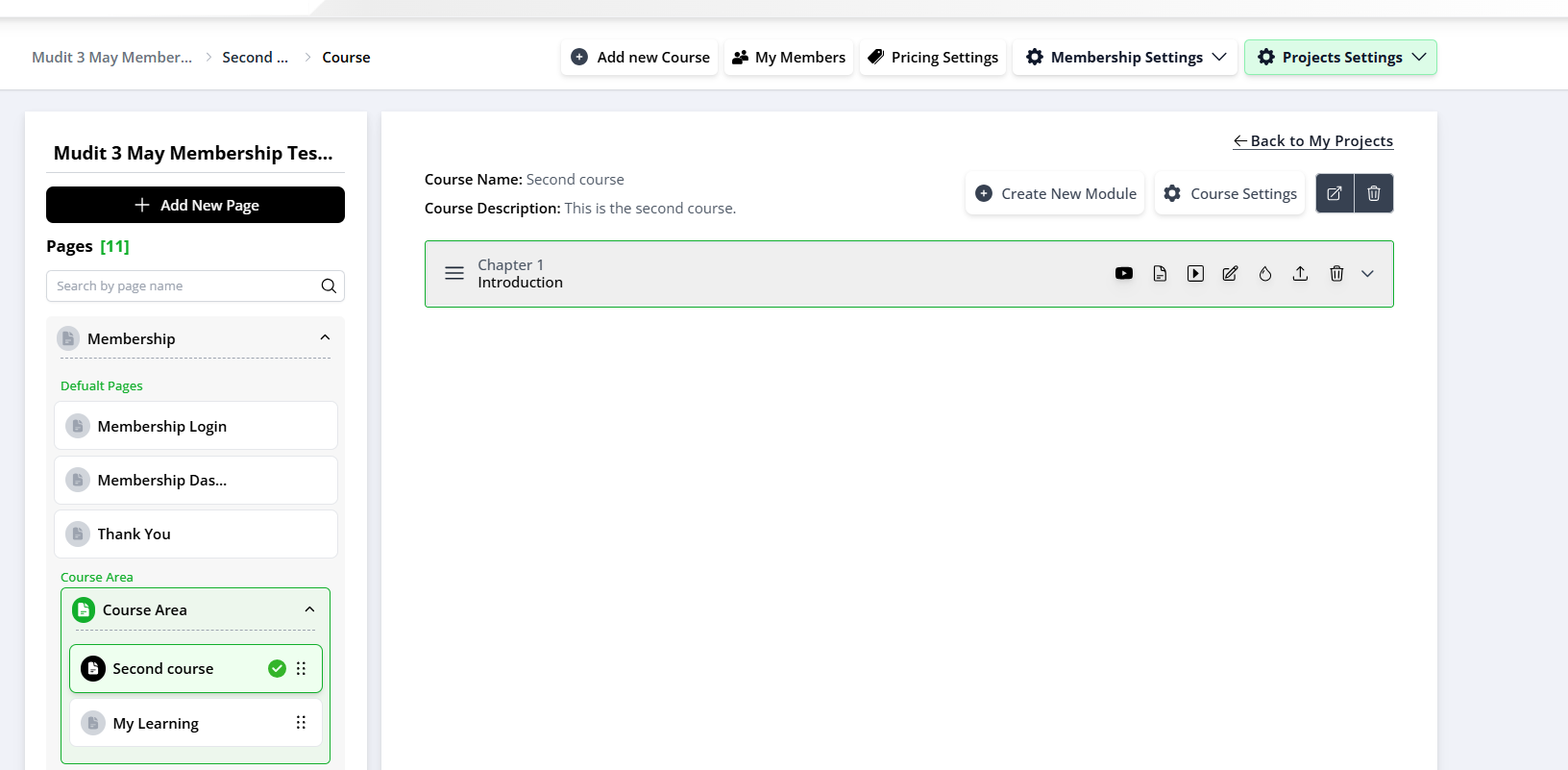
Step 1: Go to Your Course
- Log into FlexiFunnels
- Click Projects
- Open your course project
- Click My Learning tab
Step 2: Open Your Module
- Click on the module where you want to add the video
- You see a list of lessons
- Click + Add Lesson or open an existing lesson
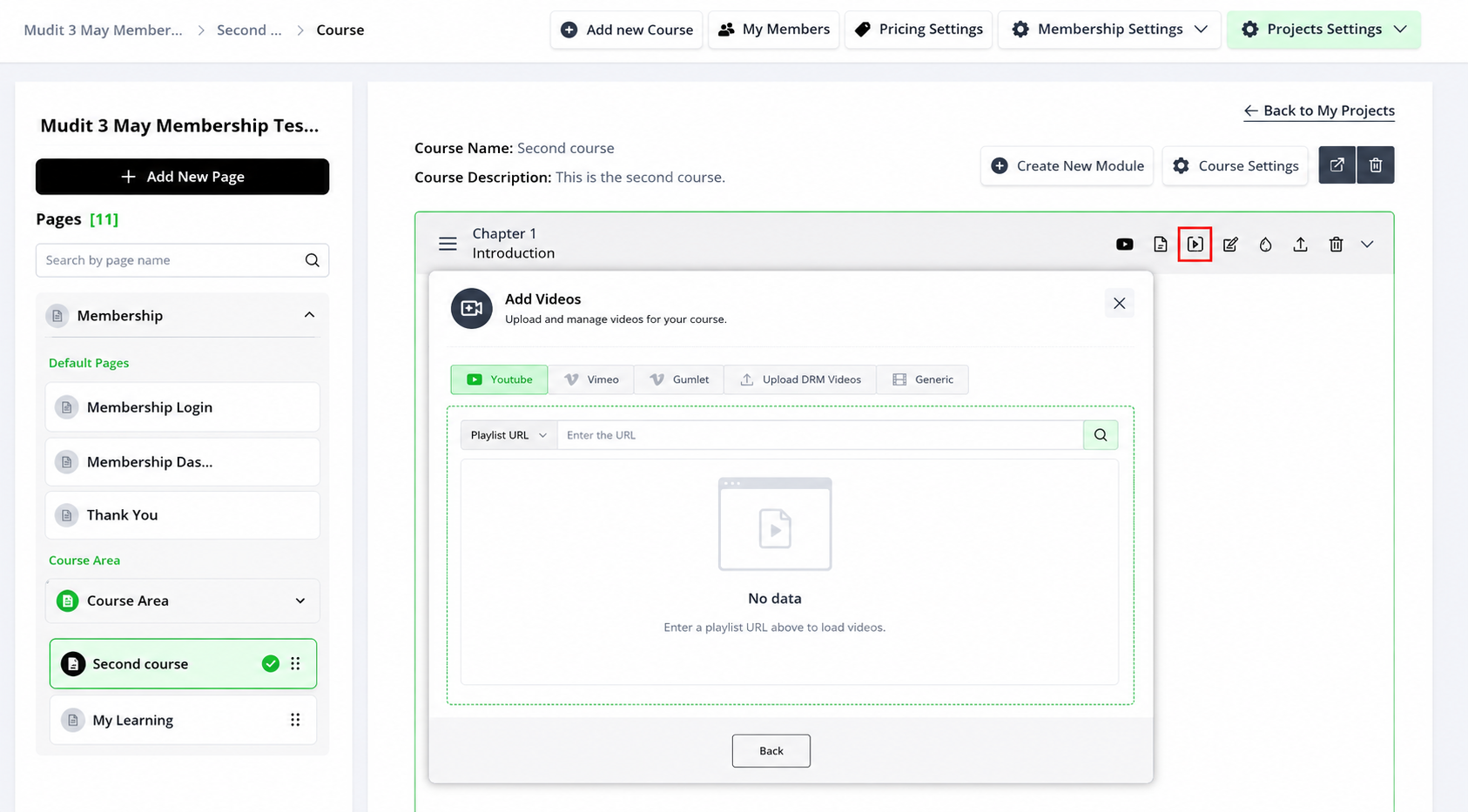
Step 3: Create or Edit a Lesson
- If creating new: Fill in lesson name and description
- Click in the Video section
- Click + Add Video button
Step 4: Click "Generic Video"
A popup appears with video source options:
- YouTube
- Vimeo
- Gumlet
- Generic Video ← Click here
- Upload (DRM)
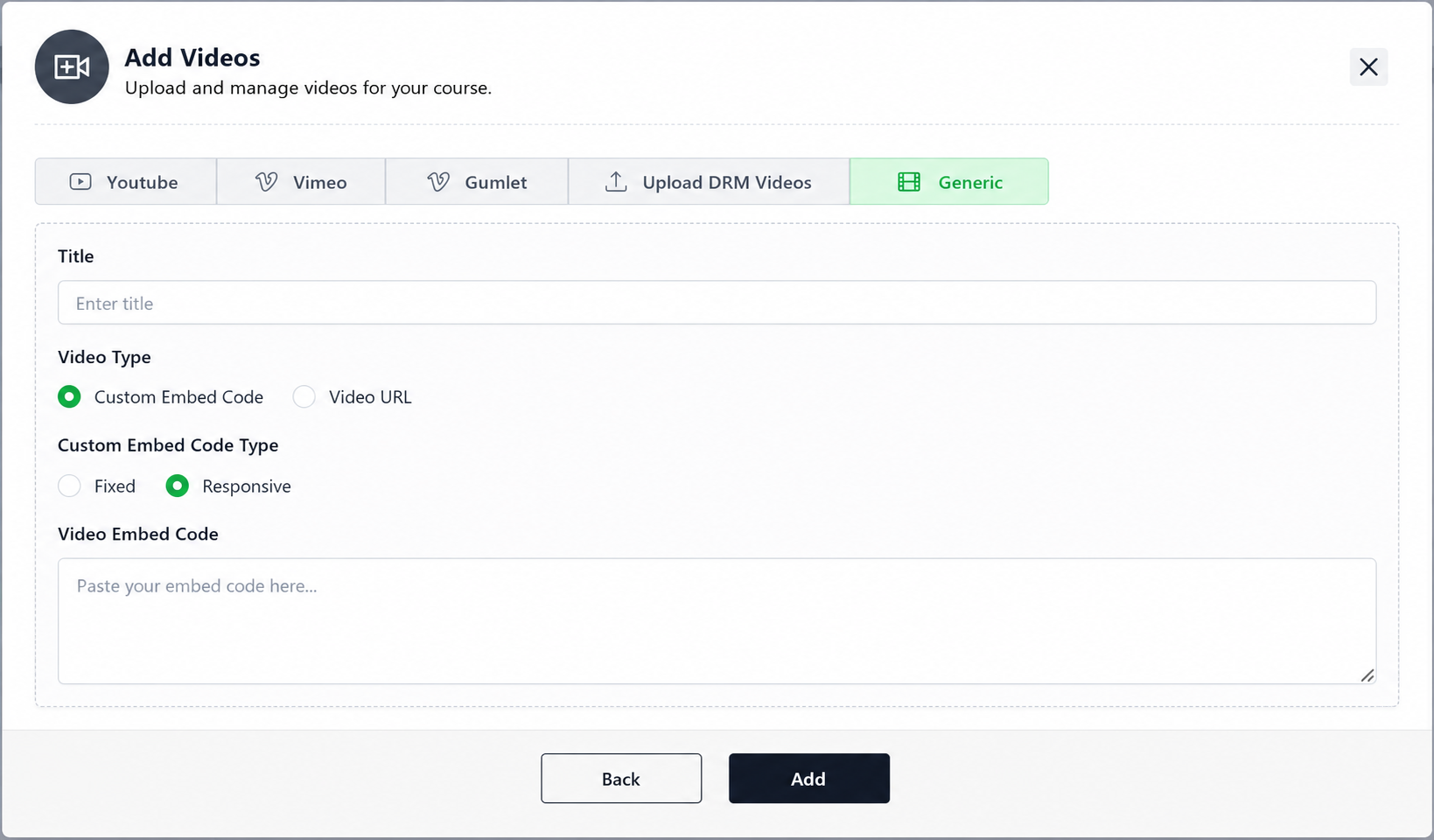
Step 5: Choose Your Method
You now see two options:
Option A: Custom Embed Code ← If your platform provides embed code
Option B: Video URL ← If you have a direct video link or MP4 file
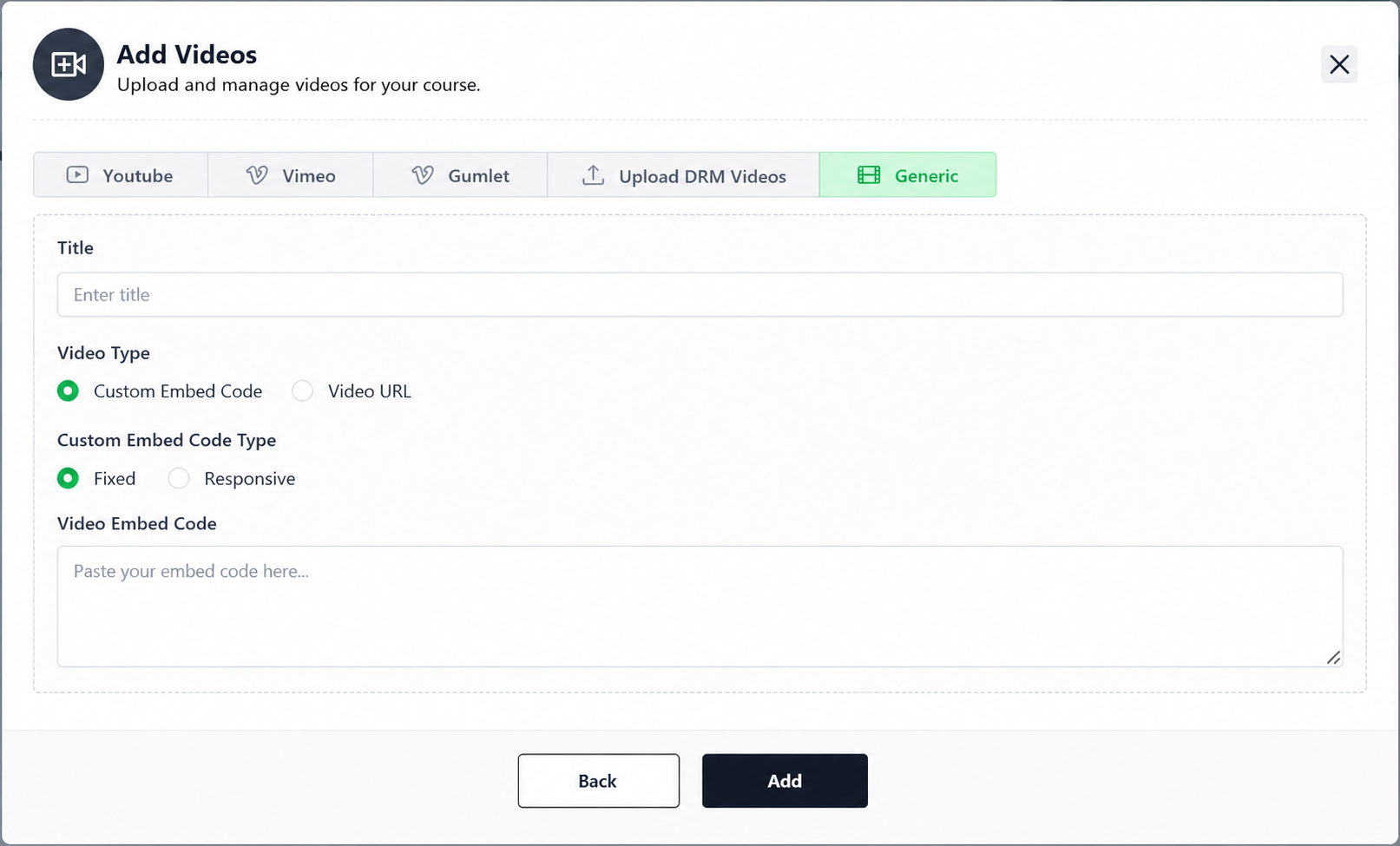
Option A: Custom Embed Code (Step-by-Step)
A1: Select "Custom Embed Code"
Click the Custom Embed Code option.
A field appears for you to paste your code.
A2: Get Your Embed Code
Depending on your platform, get the embed code:
- Wistia: Share → Embed → Copy code
- Loom: Share → Embed → Copy code
- Dailymotion: Share → Embed Code
- Kaltura: Share → Embed → Copy code
- Other platforms: Look for "Embed" or "Share" button
The code will look like:
<iframe src="https://platform.com/embed/abc123" width="640" height="360" frameborder="0" allow="autoplay"></iframe>A3: Paste the Code
- Copy the entire embed code from your platform
- In FlexiFunnels, paste it into the Custom Embed Code field
- Make sure the entire code is pasted (from
<iframeto</iframe>)
A4: Choose Layout Type
Two options appear:
Fixed Layout:
- Video size stays the same (e.g., always 640×360)
- Same on all devices (desktop, tablet, mobile)
- Use when: You want predictable sizing
Responsive Layout:
- Video size adapts to screen size
- Looks good on all devices
- Use when: You want best viewing on mobile
Recommendation: Choose Responsive (better mobile experience).
A5: Save
Click Save Video or Add Video.
✅ Your generic video is added.
Option B: Video URL (Step-by-Step)
B1: Select "Video URL"
Click the Video URL option.
A field appears for you to paste your video URL.
B2: Get Your Video URL
Depending on your source:
From a Platform:
- Get the direct video link (not the page URL)
- Example:
https://wistia.net/medias/abc123(direct link, not embed code)
From Cloud Storage:
- Google Drive: Upload video → Share → Get link
- Dropbox: Upload video → Get link
From Self-Hosted/CDN:
- Get the direct MP4 URL
- Example:
https://yourdomain.com/videos/lesson1.mp4
B3: Paste the URL
- Copy your video URL
- In FlexiFunnels, paste it into the Video URL field
- Make sure it's the complete URL (starts with
https://)
Examples:
https://example.com/video.mp4
https://wistia.net/medias/abc123xyz
https://drive.google.com/uc?id=abc123xyz&export=download
B4: Verify Format (If Uploading MP4)
If you're pasting a direct MP4 file link, make sure:
- Format:
.mp4,.mov, or.webm - File size: Under your plan limit (usually 1–2GB)
- Accessibility: File is hosted on a reliable server
B5: Save
Click Save Video or Add Video.
✅ Your video URL is added.
Understanding Layout Options (Fixed vs. Responsive)
Fixed Layout
What it does: Video stays the exact same size on all devices.
Example:
Desktop: 640×360 pixels
Tablet: 640×360 pixels (same)
Mobile: 640×360 pixels (same)
Pros:
- Predictable appearance
- Exact sizing control
Cons:
- ❌ On mobile, may be too small or cut off
- ❌ Not ideal for responsive design
Use when:
- You absolutely need consistent sizing
- Desktop-only audience
Responsive Layout
What it does: Video resizes to fit the screen size.
Example:
Desktop: 640×360 pixels
Tablet: 500×280 pixels (adapted)
Mobile: 375×210 pixels (adapted)
Pros:
- ✅ Looks good on all devices
- ✅ Mobile-friendly
- ✅ Best viewing experience
Cons:
- Slight variation in sizing
Use when:
- You want best mobile experience
- Most courses (recommended)
Recommendation: Always choose Responsive unless you have a specific reason not to.
Supported Video Formats
If uploading video files directly, these formats are supported:
| Format | File Extension | Notes |
|---|---|---|
| MPEG-4 | .mp4 | Most common, recommended |
| QuickTime | .mov | Mac-friendly |
| WebM | .webm | Open format, good compression |
Not supported:
- ❌
.avi - ❌
.flv - ❌
.wmv - ❌
.mkv
If you have an unsupported format:
- Convert to MP4 using free tools (Handbrake, FFmpeg, VLC)
- Then upload to FlexiFunnels
Common Platforms: Quick Reference Table
| Platform | Embed Code | Direct URL | Best For |
|---|---|---|---|
| Wistia | ✅ | ❌ | Interactive, professional |
| Loom | ✅ | ❌ | Screen recordings, interactive |
| YouTube | ✅ | ✅ | Free, widely used |
| Dailymotion | ✅ | ✅ | Video streaming |
| Bunny CDN | ❌ | ✅ | Self-hosted, fast CDN |
| Google Drive | ❌ | ✅ | Simple, cloud storage |
| Dropbox | ❌ | ✅ | Simple, cloud storage |
| Custom/Self-Hosted | ✅ | ✅ | Complete control |
Testing Your Generic Video
Before publishing your course, test the video:
Test 1: Check if Video Loads
- Go to edit your lesson
- Look at the video preview
- Does the video player appear?
- If not: Check your embed code or URL
Test 2: Check if Video Plays
- Click play on the video player
- Does it start playing?
- Does audio work?
- Can you skip forward/backward?
If not playing:
- Check embed code/URL is correct
- Verify video isn't private or restricted
- Try re-pasting the code/URL
- Check if platform requires authentication
Test 3: Test on Mobile
- Open your lesson on a smartphone
- View the video
- Does it resize properly?
- Is text readable?
- Can you watch comfortably?
If responsive layout looks bad on mobile:
- Switch from Fixed to Responsive layout
- Test again
Test 4: Check Responsiveness (If Responsive Layout)
- Open lesson on different screen sizes (desktop, tablet, mobile)
- Video should resize smoothly
- No black bars or squishing
- Playback quality maintained
Common Issues & Quick Fixes
❌ "Video won't load (blank player)"
Diagnostic:
Step 1: Verify embed code/URL
- Did you copy the complete code/URL?
- Check for missing characters or typos
- Try copying again from your platform
Step 2: Check if video is public
- If using Wistia, Loom, etc., is the video set to public/shareable?
- If private, video won't load in FlexiFunnels
- Change to public/shared setting in your platform
Step 3: Test the embed code/URL directly
- Paste the embed code into a new blank HTML file
- Does it work outside FlexiFunnels?
- If not, issue is with the code/URL, not FlexiFunnels
Step 4: Try a different method
- If using embed code, try getting a direct video URL instead
- If using direct URL, try getting the embed code
❌ "Video loads but won't play"
Diagnostic:
Step 1: Check browser compatibility
- Try a different browser (Chrome, Firefox, Safari)
- If it works in one browser, it's a browser issue
- Try incognito/private mode
Step 2: Clear browser cache
- Old cached data can prevent playback
- Clear cache and reload
Step 3: Check video format (if using direct upload)
- Is it MP4, MOV, or WebM?
- If not, convert first, then re-upload
Step 4: Check file size limits
- File might be too large
- Try uploading a smaller file to test
❌ "Video plays on desktop but not mobile"
Diagnostic:
Step 1: Check layout setting
- Is it set to Fixed or Responsive?
- Try switching to Responsive
Step 2: Test browser on mobile
- Try different mobile browser (Chrome, Safari)
- Clear mobile browser cache
Step 3: Check if embedded player supports mobile
- Some embed codes have issues on mobile
- Try using a direct video URL instead (if available)
❌ "Embed code displays as text instead of video"
The problem: You pasted the code into a text field instead of an HTML field.
How to fix:
- Make sure you're in the Custom Embed Code field (not Video URL)
- The field should accept HTML code
- Paste the complete code (from
<iframeto</iframe>) - Click Save
❌ "Video is too small or too large"
The problem: Fixed layout sizing isn't optimal.
How to fix:
- Check if layout is set to Fixed or Responsive
- If Fixed, consider switching to Responsive (better for all devices)
- If embed code has width/height values, you can edit:
<iframe width="640" height="360" ...> ← change these numbersMake it wider (e.g., 800) or narrower (e.g., 500) 4. Save and test
❌ "Students say they can't watch the video"
Diagnostic:
Step 1: Check if students have permission
- Is the video public or restricted?
- Do they need special access/authentication?
- Check your video platform's sharing settings
Step 2: Check their browser
- Ask them to try a different browser
- Ask them to clear browser cache
Step 3: Check if it's a platform issue
- Is your video platform having outages?
- Check platform's status page
Step 4: Provide alternative
- If one method isn't working, provide a backup (email the video file, etc.)
Best Practices for Generic Videos
1. Choose the Right Platform
YouTube/Vimeo: Free/cheap, good for simple courses
Wistia: Professional, interactive features, good analytics
Loom: Quick screencasts, interactive elements
Self-hosted: Complete control, but you manage hosting costs
2. Always Use Responsive Layout
Reason: Most students watch on mobile. Responsive ensures good experience everywhere.
3. Test Before Publishing
Why: Broken videos damage credibility.
What to test:
- Video loads
- Video plays
- Audio works
- Works on desktop, tablet, mobile
- Playback quality is acceptable
4. Have a Backup
If using external platform (Wistia, Loom, etc.):
- Have a backup MP4 copy
- If platform goes down, you can re-upload
- Protects students' access
5. Optimize File Size
For MP4 uploads:
- Keep under 1GB per video
- Use video compression tools to reduce size
- Faster uploads, faster playback
6. Use Clear Embed Code
Some platforms provide ugly or bloated code:
<iframe src="..." width="640" height="360" ... extra stuff...></iframe>Clean it up to essentials:
<iframe src="https://platform.com/embed/abc123" width="640" height="360" frameborder="0" allow="autoplay"></iframe>Most of the "extra stuff" isn't necessary.
Was this article helpful?
That’s Great!
Thank you for your feedback
Sorry! We couldn't be helpful
Thank you for your feedback
Feedback sent
We appreciate your effort and will try to fix the article